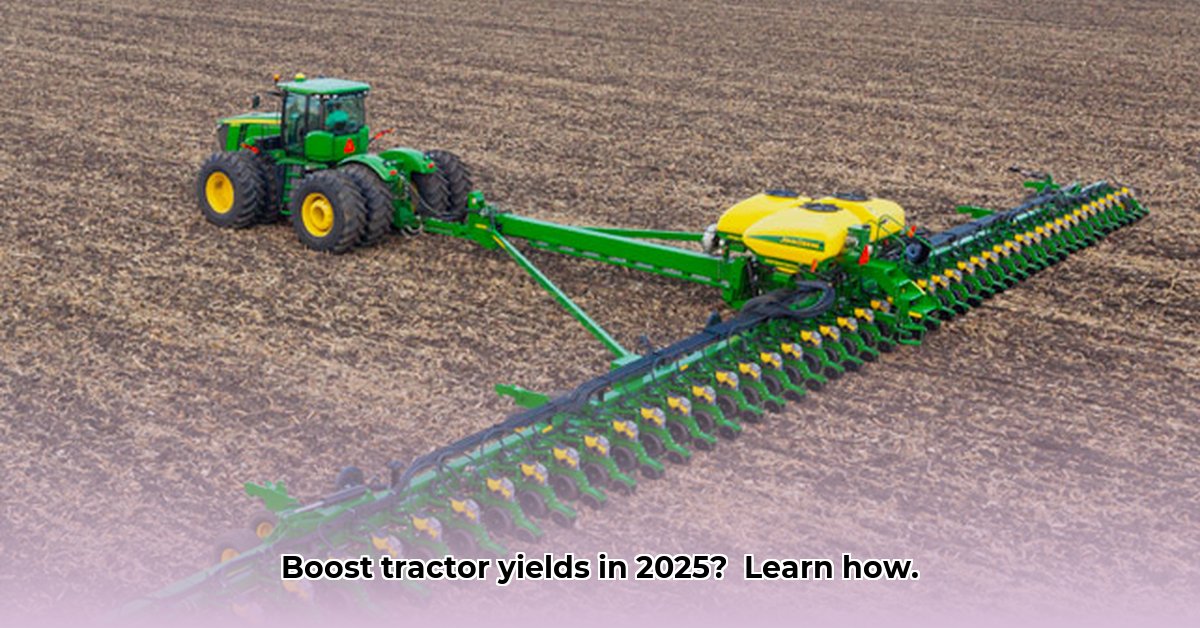
Planter for Tractor: Boosting Your Harvest in 2025 and Beyond
Farming demands maximizing land potential, and modern tractor planters significantly enhance this goal. Today's planters are high-tech field assistants, improving planting accuracy, efficiency, and profitability. Let's explore their advantages. Are you ready to revolutionize your planting process and watch your yields soar? For more on tractor attachments, check out this resource.
Precision Planting: Smarter Seeds, Bigger Yields
Precision planting transcends simply scattering seeds; it's about perfect placement. Each seed receives optimal growing conditions, resulting in consistent harvests, reduced waste, and environmental benefits. This precision is enabled by innovative technology. What if every seed had the best chance to thrive?
High-Tech Helpers: Planter Advancements
Several key innovations have transformed tractor planters into precision instruments. Consider these game-changers:
GPS Guidance (Global Positioning System): Straight Lines, Happy Plants: GPS eliminates crooked rows, preventing overlaps and gaps for a uniform crop stand. Harvesting becomes significantly easier. It's like having a built-in crop surveyor ensuring consistent spacing.
Variable Rate Technology (VRT): Tailoring to Your Field: Fields aren't uniform. VRT adjusts seed and fertilizer application based on each area's needs, optimizing efficiency and minimizing waste. This is like giving every part of your field a custom nutrient plan.
Automated Seed Metering: The Perfect Placement: Consistent seed depth and spacing maximizes germination, leading to healthier plants. This ensures that every seed receives the ideal conditions for germination.
Data Management: Your Field's Health Report: Modern planters collect data providing insights for improved strategies. This is like having a digital field manager constantly analyzing your operation and providing valuable feedback for future planting decisions.
Choosing the Right Planter: Finding Your Perfect Match
Selecting the right planter is critical. Consider these factors:
Farm Size and Crops: Small farms might use simpler mounted planters, while large operations need advanced self-propelled models. Crop types significantly influence planter feature selection.
Budget and Financing: Precision planters represent an investment. Carefully weigh costs against benefits and explore financing options like leasing.
Technological Proficiency: Planter complexity varies. Assess your comfort level with technology and access to training resources.
System Integration: Playing Nice with Existing Tech: Ensure seamless integration with existing farm management software.
Putting It All Together: A Step-by-Step Guide to Precision Planting
Implementing precision planting is a multi-step process:
Assess Your Needs: Evaluate your farm's size, crops, budget, and technological capabilities.
Research and Compare: Explore planter models, comparing features, capabilities, and prices. Read reviews and consult with other farmers.
Seek Expert Advice: Consult equipment dealers, agricultural consultants, and experienced farmers. They offer invaluable insights and practical guidance.
Make Your Investment: Decide on buying or leasing, ensuring alignment with long-term goals.
Implementation and Monitoring: Correctly install the planter and consistently monitor its performance, adjusting based on collected data.
Weighing the Pros and Cons: The Precision Planting Equation
Precision planting offers many advantages, but also some drawbacks:
| Feature | Advantages | Disadvantages |
|---|---|---|
| Efficiency | Lower labor costs, faster planting, less wasted resources, efficient input use. | Higher upfront costs |
| Yields | Increased germination rates, consistent growth, improved quality, higher yields. | Requires technological expertise and data analysis skills. |
| Environmental Impact | Reduced fertilizer and pesticide usage, less soil compaction. | Potential equipment malfunctions requiring maintenance. |
| Data Collection | Valuable information for improving strategies and maximizing yields. | Data security and privacy considerations. |
The Future is Precise: What's Next for Precision Planting?
Expect further advancements: autonomous systems, AI-powered decision-making, and more integrated data management. The future of farming is increasingly precise, efficient, and sustainable. Embrace this evolution and unlock precision planting's full potential. What innovations are you most excited to see adopted in the future?
Comparing Long-Term Cost-Effectiveness of Precision Planting Technologies
Key Takeaways:
- Precision planting offers significant long-term economic advantages despite initial costs.
- Reduced input waste leads to substantial savings.
- Optimized resource allocation maximizes yields while minimizing environmental impact.
- Data analysis is crucial for maximizing the potential of precision technologies.
- Cost-effectiveness varies based on farm size, crop type, and location.
Understanding the Economics of Precision Planting
Precision planting requires an initial investment but offers long-term gains. Traditional methods are less efficient, whereas precision planting is a targeted approach. This precision focuses on optimal seed and fertilizer placement, leading to higher returns. What factors are most crucial for you in determining the cost-effectiveness of your operation?
Technological Advancements and Their Impact
Precision planters utilize GPS, sensors, and automation to control various aspects of planting, enabling variable rate technology. This targeted approach reduces waste and increases efficiency, ultimately leading to higher yields and improved quality.
For example, John Deere's ExactShot technology demonstrates significant cost savings through precise seed and fertilizer placement. However, the initial expense might be a barrier for smaller farms. How can the adoption of precision planting technology be made more accessible for smaller farms?
Long-Term Cost-Benefit Analysis: A Deeper Dive
Analyzing long-term cost-effectiveness considers initial equipment costs, ongoing maintenance, software, and training. However, long-term benefits include:
- Reduced Input Costs: Less fertilizer and pesticides translate to significant savings.
- Increased Yields: Optimized planting leads to higher yields and greater revenue.
- Improved Crop Quality: Uniform planting improves consistency and quality, commanding higher market prices.
- Minimized Environmental Impact: Reduced input use contributes to environmental sustainability.
Choosing the Right Technology for Your Farm
Selecting the right technology depends on your farm's size, crops, and budget. Here's a simplified approach:
- Assess your needs: Identify challenges and areas for improvement.
- Research available technologies: Explore planter models and compatibility with your existing infrastructure.
- Develop a budget: Include initial and long-term costs, and consider financing options.
- Seek expert advice: Consult agricultural advisors and experienced farmers.
- Start small if needed: Gradually implement precision technologies.
Real-World Examples and Case Studies
Studies demonstrate the positive impact of precision planting. One project showed a 96.87% reduction in labor costs and a 55.47% decrease in planting time using an embedded system in India. However, results vary across contexts. How can you find case studies relevant to your specific farming context?
Purdue University: The Value of Data/Information and the Payoff of Precision Farming
Challenges and Considerations
Data management can be complex, and internet connectivity can be an issue. Robust economic models are needed to accurately compare cost-effectiveness across different farming systems. What are the biggest obstacles to adopting precision planting in your region? The future of farming is precise, and your choices today will shape your farm's success.